Quick Summary
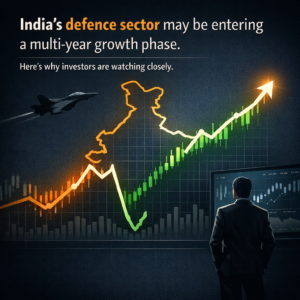
- Global defence spending is rising quickly as geopolitical tensions increase.
- India is shifting from a major defence importer to a domestic manufacturing hub.
- Government policies are pushing local production and restricting imports.
- Long-term military programs could create steady demand for Indian defence companies.
What’s Happening
Global military spending is accelerating.
Over the last three years, defence budgets worldwide have grown at about 8.6% annually, much faster than the historical average of roughly 4%. Countries are investing heavily in advanced technologies such as drones, missile defence systems, and electronic warfare.
This surge in spending is creating a powerful tailwind for defence companies around the world.
India sits at the center of this trend.
The country is currently the fourth-largest defence spender globally, and it is undergoing a major shift in how it builds its military capabilities. Instead of relying heavily on imports, India is pushing aggressively toward domestic defence manufacturing.
Several government initiatives support this strategy.
Key policies include:
- Higher foreign direct investment limits in defence manufacturing
- Procurement reforms that prioritize Indian suppliers
- Import restrictions on hundreds of defence items over time
- Programs designed to support innovation and local suppliers
Together, these changes aim to build a self-reliant defence ecosystem.
This effort is often referred to as India’s “AtmaNirbhar” (self-reliant) defence push.
Why It Matters
For investors, the shift toward domestic defence production could create a long runway of growth.
Military programs typically run for many years. Once development begins, companies involved in manufacturing, components, and systems can benefit from multi-year order pipelines.
India already has several major indigenous programs underway.
These include:
- LCA Tejas fighter jets
- Advanced Medium Combat Aircraft (AMCA)
- Quick Reaction Surface-to-Air Missile (QRSAM) systems
- Project Kusha artillery systems
- P-75(I) submarine program
Each of these projects requires complex supply chains, involving aircraft systems, electronics, radars, propulsion systems, and more.
That means demand spreads across many different defence companies, not just the main contractors.
Another important shift is happening within the industry structure.
Traditionally, India’s defence sector was dominated by state-owned companies. But today:
- Private companies
- Startups
- Small and medium enterprises
are increasingly entering the ecosystem.
Many are specializing in areas such as:
- avionics
- radar systems
- drones and UAV technology
- electronic warfare components
This broadening supply chain is helping India deepen its defence manufacturing base.
Key Numbers & Facts
- Global defence spending grew ~8.6% annually over the last three years, versus a historical ~4%.
- India is the fourth-largest defence spender in the world.
- 24%–32% of India’s defence budget is typically allocated to capital expenditure (new equipment).
- Over 1,000 defence items are expected to face import restrictions by 2029 to encourage local production.
- Many defence companies currently hold multi-year order books, reflecting long project pipelines.
Another Tailwind: Indigenization
As India produces more defence components locally, companies may see higher profit margins.
Here’s why:
- Importing complex systems is expensive.
- Domestic manufacturing captures more value within the supply chain.
- Integrator companies gain more control over components and subsystems.
As a result, localization could become a profit driver, not just a strategic goal.
Export Opportunities Are Growing
India is not only replacing imports.
It is also trying to become a defence exporter.
Examples already exist:
- The Akash missile system
- The BrahMos cruise missile
Selling complete defence platforms to friendly nations could open a large new market for Indian companies.
If export momentum builds, it could significantly expand revenue opportunities.
Investor Takeaways
1. Defence spending is entering a global upcycle.
Rising geopolitical tensions are pushing governments to increase military budgets.
2. India is shifting toward self-reliance.
Policies strongly favor domestic defence manufacturers.
3. Long-term programs provide visibility.
Projects like fighter jets, submarines, and missile systems create multi-year demand.
4. Electronics and high-tech components could benefit most.
Companies involved in avionics, radar, drones, and electronic warfare may see strong demand.
5. The sector is a long-term story.
Execution risks and procurement delays exist, but sustained government support suggests defence could remain a structural growth theme for years.