The emergence of generative AI over the past two years has sparked a market frenzy, lifting some companies into stratospheric valuations. Investors worldwide have bid up AI-related equities and poured record sums into AI startups. This piece examines the AI “bubble” hypothesis in depth: it surveys public and private market valuations, analyzes company case studies (Nvidia, Palantir, OpenAI, etc.), and unpacks broader capital-market transmission effects. We balance bubble fears with longer-term tailwinds, comparing today’s dynamics with dot-com and crypto episodes.
The AI Mania Takeoff: From 2022 to Today
Investor optimism about artificial intelligence has surged since the late 2022 launch of ChatGPT and other breakthrough AI models. Major tech firms announced massive AI spending plans, and corporate earnings started to glimpse AI-driven acceleration. Yet this has also led to a classic boom: equity prices soared on lofty expectations. For example, Nvidia – a leader in AI chips – “hit a $5 trillion market cap,” becoming the first company to do so, after its shares climbed roughly 12-fold since late 2022. Palantir, an AI software play, has similarly gone parabolic: its stock has risen over 1,000% in the last two years (and over 2,700% since January 2023), making it a retail favorite.
Globally, venture capital has been pouring into AI at an unprecedented rate. In 2025, AI-focused startups absorbed roughly half of all venture funding – about $211 billion, up 85% from 2024. Data center builders, chipmakers, and pure-play AI software firms have dominated this flow. Private AI unicorns (>$1B valuations) now make up ~12% of the Nasdaq’s market value.
However, as with any mania, questions are mounting about whether these prices are justified. Are we in a genuine new technology-led secular boom, or a bubble at risk of bursting? In one view, US stocks look “priced for perfection,” with cyclically-adjusted P/E ratios (CAPE) in the high 30s – levels only surpassed in the dot-com era. In another, analysts note that today’s leaders have strong profits and cash flow. We will unpack these dynamics, weighing the key drivers of AI’s rise and the red flags of excess, section by section.
AI Giants on the Public Market: Case Studies in Frenzy
Nvidia: The AI Chip King
Few examples capture the frenzy like Nvidia (NVDA). As Reuters reports, Nvidia became the first company ever valued at $5 trillion in October 2025, after “a rally that has cemented its place at the center of the global artificial intelligence boom.” The chipmaker’s shares have rocketed about 12x since late 2022, far outpacing broad indices. Analysts note that Nvidia’s rise is fueled by immense demand for its GPUs in cloud data centers and for training large AI models. Major deals – including “$500 billion in AI chip orders” announced by Nvidia and a reported $38 billion chip supply deal between OpenAI and Amazon – have underscored the scale of AI capital expenditures.
Yet this hyper-growth comes with extreme valuations. After hitting $5T, Nvidia’s forward P/E is still in the high 30s or low 40s (despite near-term earnings growth), reflecting investor faith in far-future profits. A top fund manager quipped that Nvidia’s stock climb had left the rest of the “Magnificent Seven” megacaps “far behind”. Such prominence has also made Nvidia’s trajectory a key risk for the market. RBC Wealth Management points out that Nvidia alone is “nearly eight percent” of the S&P 500, meaning any setback (earnings miss, regulatory issue, or macro shock) could have outsized index impact.
The case of Nvidia illustrates a core bubble dynamic: spectacular gains can overshadow fundamentals. The company’s fundamentals are strong – it has robust margins and free cash flow – but its stock price fully incorporates expectations of perpetual AI-driven growth. In fact, as the ETF.com analysis notes, Nvidia’s 5-year performance (+14x stock, +20x earnings) looks exceptional, yet still does not match the later 1990s tech bubble in scale. Nonetheless, Nvidia’s leadership amplifies market concentration: one firm now rivals entire sectors in weight. This concentration raises valuation and risk questions we’ll discuss below.
Palantir and Other AI Hype-Stocks
On the software side, Palantir (PLTR) epitomizes the “AI darling” mania. Once a modest government-data firm, Palantir rebranded as an enterprise AI analytics play and saw its stock “grow by over 2,700% since January 2023”. More recent data show its two-year surge at roughly 1,000%. Palantir now boasts tens of billions in annual revenues from corporate and defense contracts, but trades at extremely stretched multiples. Reuters notes that Palantir’s stock hit these heights even after a strong earnings beat – “surge[ing] nearly 9%” – only to slump on concern over frothy valuations.
Notably, Palantir’s forward price/earnings ratio is roughly 250x current estimates, compared to about 33x for Nvidia and 30x for Microsoft. In other words, Palantir investors are paying extreme premiums for future growth hopes. This has drawn skeptics: famed short-seller Michael Burry even bet against Palantir (and Nvidia) in 2025, warning of an AI bubble. Yet some bulls argue Palantir’s software could command a trillion-dollar valuation if it maintains growth – a reflection of how outsized expectations have become.
Beyond Palantir, other AI-related names have soared. Chipmakers like Broadcom and AMD also hit record highs in 2025 on AI demand. Even legacy tech firms (Apple, Alphabet) saw run-ups partly fueled by AI strategy announcements. Index-wide, about a third of S&P 500 market cap now comes from the top 10 names, largely these tech giants. Many of these firms indeed enjoy strong profits and balance sheets, but their sheer size has distorted index valuations and market behavior. We will return to how this concentration affects investors.
The Private Side: Startups, Unicorns, and OpenAI
A Venture Avalanche into AI
The public market frenzy has a private counterpart. Venture capital poured into AI startups at record pace in 2023–25. Crunchbase reports that global venture funding jumped to $425 billion in 2025, up 30% from 2024. Remarkably, roughly half of all venture funding last year went to AI-related companies. A handful of mega-rounds dominated the totals: OpenAI, Anthropic, xAI, Scale AI and others raised billions each – the top five deals alone consumed $84 billion (20% of all VC money).
This concentration of capital is extraordinary. By year-end, the combined value of unicorn startups (>$1B) approached $7.5 trillion, driven mainly by five names: SpaceX ($800B), OpenAI ($500B), ByteDance ($480B), and Anthropic ($183B), plus one more. In effect, private AI companies are valued in the many hundreds of billions, even as most are far from profitable. OpenAI alone raised $40B in 2025, with reports of eye-popping requests of $100B (the largest round ever), as investors clamor for exposure to generative AI.
Yet this money is largely funding burn rates, not profits. OpenAI’s case is illustrative. Having generated ~$13B in 2024 revenue, OpenAI is projecting to spend roughly “$115 billion of cash by 2029” – funds it doesn’t currently have. Analysts estimate its net losses could total $143–$207 billion over the rest of the decade. Much of this goes into data centers and computing capacity. In fact, OpenAI has secured deals totaling dozens of gigawatts of compute power – nearly one-third of global industry usage. Satya Nadella’s Microsoft even warned that nearly half its cloud backlog is tied to OpenAI projects.
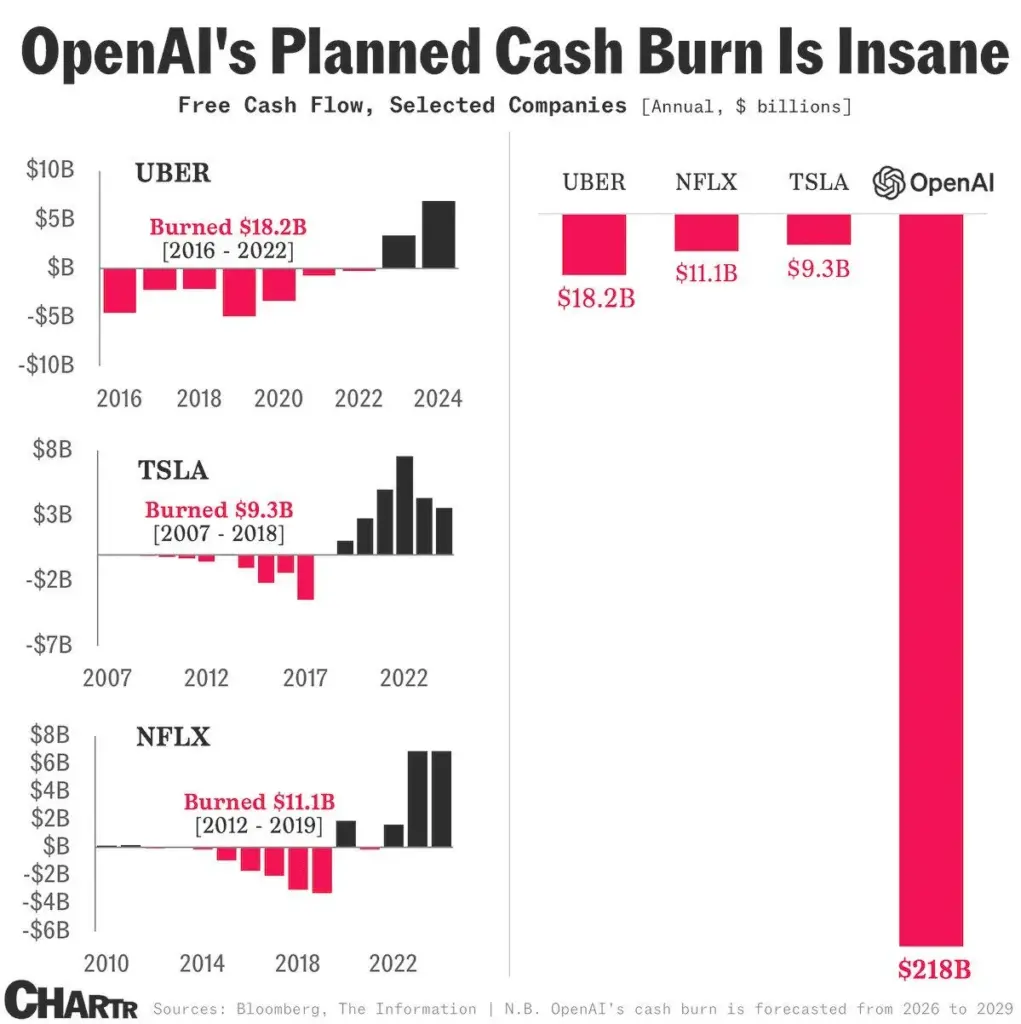
This burning of capital on that scale is unprecedented. One Wall Street research note called OpenAI a “cash incinerator”. Private investors are betting that scale and AI “moats” will eventually pay off – a familiar refrain from past bubbles. Meanwhile, skeptics like those who pointed out that “valuations are based on potential, on TAM… not on revenue” suggest many startups may not survive. As a cautionary note, industry studies find over 90% of enterprise AI pilots fail to deliver measurable value, implying that most early-stage AI bets could blow up.
Structural Themes: AI’s Economic Impact
While bubble talk captures headlines, the AI wave does rest on some fundamental trends. Structural shifts are under way that could sustain higher tech spending over time – even if not at today’s breakneck pace. Key themes include:
- Hardware and Infrastructure Build-out: Hyperscalers (Amazon, Microsoft, Google) are massively expanding data centers and specialized facilities for AI. New chip architectures (Nvidia’s Blackwell, AMD’s MI300, Intel’s Gaudi) are being rolled out. The global market for AI datacenter hardware is projected in the hundreds of billions over the next few years. This means sustained capex in semiconductors, GPUs/TPUs, memory, and networking. Even if valuations seem high, earnings reports show real demand: Nvidia announced $500B in chip orders, and others report multi-year commitments for AI servers.
- Cloud and Software-as-a-Service Migration: Enterprises across industries are beginning to adopt AI platforms (for customer service, data analysis, coding, etc.), often via cloud partnerships. This implies a long-tail revenue opportunity for big cloud providers and specialist AI software firms. For instance, Grand View Research expects the AI platform market to grow over 35% annually through 2033. Importantly, many companies in 2025 reported strong AI-driven revenue growth: Palantir (70% yoy in Q4’25), cloud AI service providers, and even traditional software vendors incorporating AI modules.
- Labor and Productivity: A long-term tailwind is the potential productivity gains from AI automation. If AI tools boost worker output or enable new products, the underlying economy could grow faster. Investors who believe in AI’s value argue we are in a “new computing era” like the internet or PC boom, and that today’s investments will pay off in higher profit pools. Even Vanguard notes that US growth could be 2–2.5% partly thanks to AI investment, against more subdued growth elsewhere.
These tailwinds suggest that not all AI hype is baseless. Many leading AI stocks are indeed the beneficiaries of real secular change. However, it is crucial to distinguish valuations from fundamentals. For example, an ETF strategist observes that for broad AI stock indices, “the forward P/E multiple of publicly traded AI stocks has declined, while earnings per share have more than doubled.” This indicates recent AI stock gains have largely come from rising earnings, not from ever-expanding P/E ratios. In Nvidia’s case, 5-year earnings rose 20x (driving its 14x price rise). Such metrics argue that, at least so far, fundamental profits have somewhat justified investor bets.
Bubble Comparisons: Dot-Com, Crypto, and History
No discussion of an “AI bubble” is complete without comparisons to prior tech manias. The dot-com era (late 1990s) is the obvious reference point. In some respects, there are parallels: dramatic concentration in tech stocks, sky-high valuations. A recent index analysis highlights that today’s top tech names generate vastly more earnings and have much higher profit margins than dot-com-era leaders, and their P/E multiples are far lower (today’s Nasdaq P/E in the low-30s vs. ~100–200 in 2000). That suggests valuations are not yet as extreme as 2000.
Yet echoes remain. During dot-com, tech exuberance became disconnected from profits. The GNP (formerly GMO) strategist Jeremy Grantham warns that many investors are “discounting the future as if…record earnings [and] rapid advances in AI…are guaranteed forever.” He argues this over-optimism is historically dangerous: when confidence inevitably falters, a “major stumble” and “severe decline in valuations” could follow. Grantham does note that the usual crisis signals (mass failure of speculative firms, sharp underperformance by formerly hot stocks) aren’t fully evident yet, implying perhaps there is more of a run-up to come.
Crypto’s boom-and-bust (2020–22) provides another parallel. That cycle too was driven by new technology (blockchain) and easy money, leading to stratospheric valuations (some crypto startups reached $10–$100B) and equally staggering losses. Like blockchain, AI is a deep-tech wave with many tall promises but uncertain business paths. Many AI startups resemble Crypto projects in that they raise on hype rather than revenue, so the concern is similar: a lot of “code+promises” without profits. Indeed, some observers noted that, just as crypto’s speculative frenzy drew mass retail participation, today’s AI theme is a top concern among individual investors. (One CNBC panel quipped that AI mania has become “worse than 1999” in terms of investor zeal.)
In sum, history tells us bubbles inflate beyond fundamentals. Equity strategists highlight differences today: Far fewer tech firms are unprofitable now (~20% of tech companies) than in the late ’90s (~36%), and companies generally have much stronger balance sheets. That suggests some greater stability. But even so, overvaluation risks remain: one Vanguard analysis notes the U.S. equity risk premium is now “compressed,” meaning stock prices offer only a “small excess return over bonds”. In a bubble, the expected future returns embedded in prices become very low – a precarious place for investors.
Index Concentration and Passive Flows: Transmission in Capital Markets
One defining feature of the current cycle is how narrow the market has become. As RBC Wealth reports, the top 10 companies in the S&P 500 now account for ~41% of the index’s total market cap. To put that in perspective, from 1990 to 2015 the top 10 hovered around 19–23%; they only reached ~28% at the 2000 peak.
This “Great Narrowing” has major implications. When a few stocks dominate, the index’s fate hinges on their fortunes. RBC points out that currently 40 cents of every dollar invested in the S&P 500 via index funds end up in those same 10 companies. In effect, passive flows are exacerbating concentration: buying the index increasingly means buying a levered bet on a single theme (AI/Big Tech). This feedback loop inflates the largest stocks’ weights regardless of fundamentals.
The skewed market also affects style performance. Growth stocks (with high expected future earnings) have far outperformed value stocks in recent years, widening traditional growth–value dislocations. For example, T. Rowe Price notes that since the 2008–09 GFC, the Russell 1000 Growth index has outpaced Russell 1000 Value by over 114%, whereas historically value had a premium. They show that growth stock prices (cumulative) have roughly tracked their earnings gains this time, whereas in 1999–2000 prices soared far beyond profit growth (a classic bubble signature). Today’s index-level P/E ratios are high by most standards – U.S. CAPE ~35–40 – but not nearly as extreme as dot-com (Nasdaq P/E over 100 at peak). The distinguishing factor is that earnings remain robust, especially for the megacaps, which has so far helped to justify elevated prices.
Market Liquidity, Risk Premiums, and Volatility Regimes
In Vanguard’s analysis, U.S. equities now trade at a small premium to global bonds, compressing the Equity Risk Premium. In plain terms, if investors are paying high prices now (low ERP), their long-term reward is limited unless earnings growth justifies it.
Meanwhile, venture and credit markets exhibit signs of strain. AI-inspired financing deals – from hyperscaler debt issuance for data centers to complex convertible bonds (like Oracle’s recent “jumbo” AI-linked issuance) – have returned to peak levels. Private equity and VC underwriting are being watched for deterioration. So far, big tech firms fund AI mostly via internal cash flow: J.P. Morgan notes that aggregate operating cash flows still exceed their combined AI capex and dividends. But as AI builds out, leverage will rise. The analogy to dot-com vendor financing (WorldCom, Lucent) is apt: we see vendor deals (e.g. chipmakers financing AI data centers) that could create circular dependencies and over-commitment if demand assumptions prove too optimistic.
The interaction of AI with global liquidity is also critical. If central banks tighten aggressively to counter inflation, high-flying tech valuations might reset. Conversely, some argue central banks will avoid sparking a tech crash, fearing collateral damage. Either way, the current mix of high risk-taking and high asset prices leaves little room for error in monetary or fiscal policy.
Valuation Distortions and Imbalances
One way to gauge a bubble is to look for valuation distortions. Clearly, AI-related assets trade at premiums to traditional peers. J.P. Morgan provides eye-opening stats: median Series C AI startups value ~56% higher than non-AI peers, and at Series D+ they’re 230% higher. On the public side, JPMorgan also notes that AI stocks’ recent gains have come entirely through earnings growth, not P/E expansion. In fact, for major AI-exposed stocks the forward P/E has actually contracted (Nvidia’s P/E fell from 39x to 26x while EPS tripled in 2.5 years). This implies investors are viewing current high prices as justified by near-term profits – but it also shows just how steeply future cash flows were anticipated.
Nevertheless, outliers abound. Palantir at ~250x forward earnings starkly contrasts with value names trading at single-digit multiples. If Palantir’s earnings falter or normalize, a huge valuation gap could force a painful reversion. More broadly, the market’s cap-weighted vs. equal-weighted disparity is historic. Over the last three years, the cap-weighted S&P 500 outperformed the equal-weighted version by ~32% – one of the largest premiums on record. A large chunk of that came in the past 18 months, roughly matching the late 1990s tech bubble period. This shows the rally has been highly concentrated among mega-caps.
Another distortion is sectoral. Information Technology and Communications Services (the “tech” sectors) now command much higher allocation in indices, dwarfing industrials, energy, and financials. Money often flows in “forbidden fruit” chasing returns, leaving cyclicals and value sectors unloved. We have seen that play out in India’s markets as well: when global tech came under pressure, Indian IT services and tech stocks fell sharply (the so-called “software-maggedon”wiped ~$50 billion off firms like Infosys), even though India’s economy was fundamentally strong.
Finally, some have pointed to credit and debt nuances. AI companies, including big tech, have used creative financing (vendor financing, convertible bonds, etc.) to fund growth. While headline interest rates are high, major AI beneficiaries still enjoy strong credit ratings and low bond yields. J.P. Morgan charts show that the biggest cloud/AI players (Microsoft, Google, Amazon, Meta) have far lower leverage and tighter spreads than the corporate average – a sign they are not yet starved for capital. But if these firms chase expansions aggressively, leverage will rise, potentially amplifying shocks if the cycle turns.
Primer — Growth vs. Value: “Growth” stocks are companies expected to grow profits rapidly (often at a higher price), while “value” stocks trade cheaply relative to fundamentals (often more mature firms). Historically, growth outperforms in bull markets and value in recoveries. Today’s AI era has exaggerated growth-value gaps: tech-oriented growth indexes are dominated by a few mega-caps. However, as one analysis notes, much of growth’s 2021–25 outperformance has been backed by actual earnings, unlike dot-com times. Importantly, valuation signals now lean toward value: when value has been this inexpensive relative to growth in the past, it usually outperformed in the following year. In other words, if the cycle shifts, value stocks may rebound strongly.
Transmission to Other Markets and Economies
Beyond equities and startups, the AI bubble narrative ripples across the wider financial system and the global economy.
- Liquidity and Credit: If an AI-led sell-off hits, liquidity could dry up as margin calls force selling. Credit markets could see stress – for instance, banks and funds heavily exposed to tech lending might tighten lending standards. Already, some risk managers are eyeing “softer” underwriting in AI-related loans and leases. On the flip side, during the boom, large tech firms have borrowed to finance AI investments. To date, their cash flow has covered most spending, but any abrupt cycle turn could leave them service debt burdens or drain cash reserves.
- Volatility Regimes: AI hype has contributed to historically low volatility in 2024–25 as bulls assumed the theme would continue indefinitely. If that mindset cracks, we could return to choppier markets. The VIX index, for example, sits below historical average – in part because the “Magnificent 7” have anchored returns. A few bad earnings or tech-policy shocks (trade curbs, AI regulations) could send volatility spiking. Indeed, some risk strategists argue that a correction in AI stocks might provoke a wider stock market rotation, as happened in late-1990s bull runs.
- Flows and Market Breadth: One important transmission channel is how flows rotate across regions. Indian equities provide a case in point. As Reuters reports, India’s markets largely “sat out” the global tech rally, trading as an “anti-AI” story. With India’s GDP growth strong and its sectors more domestically driven, investors are now reconsidering India’s relative value after seeing foreign outflows during the US tech boom. In early 2026, India saw net foreign inflows (~$1.5B) even as the Nasdaq gave back earlier gains. This suggests a potential rebalancing: money rotating from overheated AI sectors into more traditional or emerging markets. For Indian investors, this emphasizes diversification: participation in the global tech story can be one leg of a portfolio, but the domestic growth story remains a separate tailwind.
- Second-order Economic Effects: If an AI bubble bursts, the effects on the real economy could be notable. Tech-sector job cuts might occur after a boom (we saw big tech layoffs in 2022 after crypto and AI rallies plateaued). Supply chain consequences could arise: memory chip makers, semiconductor fabricators, and datacenter builders would all feel pain. Conversely, if AI investments continue apace, they could eventually boost productivity and support corporate earnings more broadly (benefitting labor, boosting new industries, etc.). Regulation is also a factor: some countries have begun scrutinizing AI’s labor and data implications. Sudden policy shifts could either throttle a bubble (through taxes or controls) or inadvertently deepen it (through lax oversight).
- Comparative Assets (Crypto, Commodities): AI hype has so far not produced a new cryptocurrency-style bubble, but history suggests a possibility of spin-offs. Crypto and memecoin sentiment in 2023–24 rode on the same speculative wave as tech stocks. If tech stocks reverse, crypto markets could tumble anew (they did during 2022’s broad tech slide). On commodities: data center metals (like copper) have seen modest rallies on AI buildout expectations, but a full-blown tech crash could soften industrial demand projections.
- Volatility Spillovers: A sharp tech correction would likely trigger volatility contagion to other asset classes. Even fixed income could see moves: a typical reaction might be “flight to quality,” raising bond prices (lower yields) initially, but if the downturn is seen as deflationary, central banks might cut rates, pushing yields even lower. Alternatively, if a bubble pop threatens bank stability or inflation, yields could rise on risk-off.
Assessing Bubble Risk vs. Opportunity
In summary, the evidence suggests a mixed picture. On one hand, the setup has bubble hallmarks: extreme stock moves, high multiples, huge private capital flows, and widespread investor mania. RBC warns that the index’s top-heavy structure “warrants scrutiny,” because what seems diversified is really an “AI bet”. JPMorgan states that “every bubble attracts new participants…Exuberance is building” in AI stocks. OpenAI’s gargantuan cash burn and investor concerns echo past “irrational exuberance” tales.
On the other hand, some fundamental justifications exist: strong profits in leading tech firms, real enterprise demand for AI tools, and a secular shift in technology. Compared to dot-com, today’s tech leaders make profits far greater (Nasdaq’s big names net ~$630B in 2025 vs. $27B in 1999) and have healthier balance sheets. ETF.com notes that at the index level, “today’s Nasdaq‑100 bears little resemblance to that of the late ’90s,” with most holdings being fundamentally strong, diversified companies. Growth–value gaps have widened, but earnings growth has largely underpinned share prices so far, unlike pure speculation.
The balance of risks versus rewards depends on assumptions. If AI adoption continues accelerating for years, current valuations might look reasonable. In that scenario, owning the leading AI bets (the “Magnificent Seven” + a few others) could continue to outperform. However, if competition (AI is far from a one-winner field), regulation, or capital constraints slow growth, the current prices may prove unsustainable. As Morgan Stanley’s Michael Mauboussin said about technology cycles, “sooner or later every great bull market runs out of bulls.”
A useful lens is Jeremy Grantham’s: one should ask if “current conditions [are being] discounted as if guaranteed forever”. Right now, many investors do expect AI returns with near certainty – a high bar. The gambler’s cautionary tale applies: enjoying a rally is fine, but betting the house requires realism about probable outcomes. India’s experience – a market with limited tech exposure – shows another angle: bubbles often create arbitrage by leaving some markets uninflated. If foreign investors lose faith in global AI plays, emerging and value assets may get a bid, mitigating some fallout.
Conclusion
The AI boom has reshaped markets, propelling a new generation of tech titans while fueling a swirl of speculation. This article has unpacked the situation: highlighting the stratospheric gains of companies like Nvidia and Palantir, the record private funding of startups, and the narrow market structure that’s developed. We’ve weighed these developments against structural tailwinds – true demand for AI hardware and software, and potential productivity gains – as well as against the clear warning signals of a bubble.
Our analysis finds that yes, risks of a speculative bubble are present, especially given valuations and concentration. Yet we also acknowledge that underlying technology advances are real and enduring to some extent. For institutional-quality clarity, investors should stay vigilant: track not just stock prices but key indicators (profitability trends, funding conditions, breadth of participation).
Ultimately, the goal is balance. The AI era may indeed bring transformative change, but as history and theory remind us, those who bought into the last great tech mania at its peak (in 2000) fared poorly when the bubble burst. Calibrated exposure – capturing innovation while limiting overbetting – is prudent. In practice, that means picking winners carefully, setting reasonable price targets, and maintaining diversification in portfolios. High conviction may reside in the belief that AI will matter enormously, but even the best long-term investors must guard against exuberance: as one investor quipped about AI and bubbles, “Time will tell.”
Sources: This article draws on a wide range of market research and news reports. Key data and analysis are cited above from RBC Wealth Management, Reuters and other financial news, Crunchbase VC reports, Vanguard and JPMorgan institutional research, and others, as noted. Each section’s insights are anchored in the facts from these sources to provide a thorough, up-to-date assessment of AI’s impact on markets.